What builds up, and why it matters
On this kind of work the problem is dried ink, adhesive, paper dust and coating build-up. Anilox and press rollers are precision surfaces. Anything abrasive changes the cell structure and changes the print, which is why solvent soaking and manual scrubbing are the usual compromise.
Presses are cleaned in place between runs or during planned maintenance. The people who call us about packaging machine are usually press operators and production managers, and the thing they are actually worried about is altering a roller surface and with it the print result.
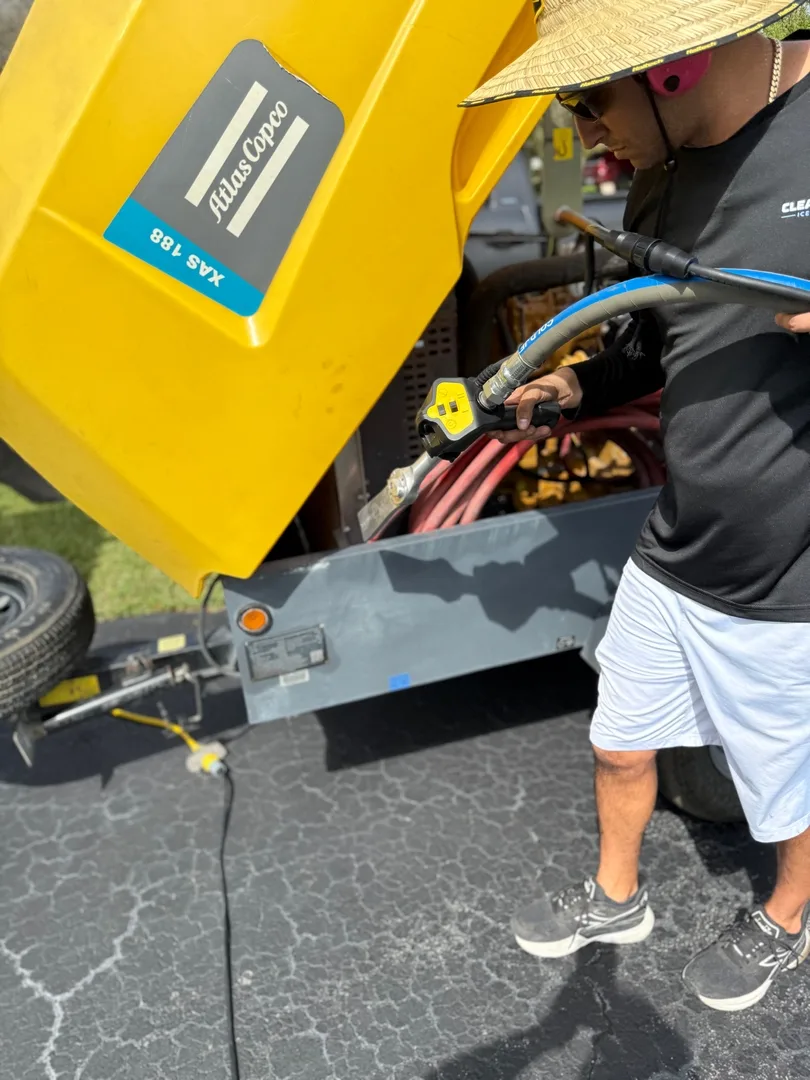
The method
Why dry ice and not the alternatives
- Non-abrasive
The pellet is soft and sublimates on impact, so the work is thermal rather than mechanical. Machined faces, plating, paint and gaskets survive it.
- Low moisture
Nothing gets wet, so nothing has to sit and dry. The time saved goes straight back into running the equipment.
- No secondary waste
Cleanup is just the buildup itself. The media vanishes, so nothing ends up in seams, drains or bearings that needs flushing out later.
- Often no teardown
Disassembly is where the labor hides. With dry ice, much of it is not needed, which is where most of the saving shows up.
More printing work
Related jobs we get called for
Questions we get asked first
Will it damage the surface underneath?
Dry ice is soft compared with most blasting media and leaves the substrate as it found it. We still check an inconspicuous area first, because an honest answer beats a surprise.
Do you have to take the equipment apart for packaging machine?
For most jobs, no. Reassembly is where time and money normally go, and cleaning in place skips both. If a part has to come off, we raise it when we look at the job, never halfway through.
How much mess does it make?
It depends on how much is caked on, since that is all that comes off. The ice adds nothing to the pile, and we clean up what is there.
Do you come to us?
We do. Everything runs out of our truck, so you never haul anything to us. We work from Miami across South Florida, out to about a hundred miles.
What does a job cost?
We need to understand the job before we can put a number on it, so the first step is you telling us about it. Photos make that faster. The figure you get back comes from one of the owners and reflects the actual work.
How soon can you look at it?
Most of the delay is waiting on details. Once we know what the part is made of and what is stuck to it, we can tell you when we can come and whether dry ice is right for it.
The comparison
The other ways to do this
- Hand scraping
Slow, inconsistent, and the tool marks the surface. Fine for a small area, unworkable across a machine.
- Media blasting
It works by removing material, which is the problem. Acceptable on heavy steel, damaging on soft alloy, plating or a machined surface.
- Pressure washing
The water has to go somewhere, and on most equipment that somewhere is inside it.
- Solvent and degreaser
Softens the contaminant but leaves a film, fumes and a disposal problem, and attacks finishes you meant to keep.
- Dry ice
It is the only one on this list where the media stops existing the moment it has worked.
What comes off
What this takes off
The method does not care much what the contaminant is, only that it sits on top of something. Here is the usual list.
- Food residue
Burnt-on product, fat and sugar on processing gear, with no chemical residue left on a contact surface.
- Grease and oil
Thick grease that has been sitting for years comes off too, it just takes more passes. Fresh oil film is quicker, and both leave nothing behind but the grime itself.
- Carbon and soot
The dark scale on ovens and exhaust parts. Of everything we remove, this is often the quickest to release, because the bond is a heat bond.
- Adhesive and sealant
Whatever the last repair left stuck to the mating face: gasket, sealant, deadener or adhesive.
- Resin and mold release
Release agent and resin build-up on tooling, where a solvent fix trades one residue for another.
- Paint and coatings
Selective removal, layer by layer, on parts where media blasting would cut into the substrate.
- Salt and corrosion product
A constant in South Florida. Removing it without stripping the protective finish is the whole trick.
How a job runs
The sequence, start to finish
There is no mystery to how these jobs run, and no part of it we would rather you did not ask about.
- You look before we pack up
We would rather you find the missed spot while we are standing there than a week later. Another pass on the day is the cheapest fix available.
- You describe the job
Describe the equipment and the mess. If it cannot come offline that changes the plan, so say so early.
- We look at access and containment
Anything that should not be blasted gets covered first. On a control cabinet that might be a few components, and on a food line it might be most of what surrounds the area we are cleaning.
- We test a small area
Pressure and pellet size get dialed in on an inconspicuous spot before we touch anything visible. Painted parts, soft alloys and older finishes all behave differently, and the right setting on one is the wrong setting on another.
- We blast, then clean up
One mess instead of two: the pellet vanishes and we take away what it removed.
Before we turn the rig on
We cover what should not be hit before anything gets blasted. It takes minutes and saves arguments.
No toxic fumes and no film are left on your equipment. What we do manage is oxygen, because CO2 gas fills an enclosed space as the ice sublimates. Ventilation is set before anyone starts blasting.
This is not a quiet method. Ear defenders are standard issue on site for anyone nearby.
Nothing wet goes onto your equipment, but cold metal in warm air can still pick up condensation. It clears as the part comes back up to temperature.
Tell us what needs cleaning.
What is it, where is it, and what is stuck to it? That is enough to start. Giancarlo or Kenny will answer personally.