Home / Services / Industrial / Weld Cell
Industrial · Miami, FL
Weld Cell Ice Blasting
Weld Cell comes to us when the usual cleaning methods are too harsh for the part. We clean it without water, without chemicals and without anything abrasive touching the surface.
What builds up, and why it matters
On this kind of work the problem is baked-on process residue, oil film, carbon, swarf and release agent. Production equipment is expensive to take apart and expensive to leave down. Solvent means ventilation and disposal; water means waiting; abrasive means grit in a machine you just cleaned.
Most industrial work happens in place, during a shutdown or a maintenance window. The people who call us about weld cell are usually maintenance leads and plant managers, and the thing they are actually worried about is that the line does not come back up on schedule.
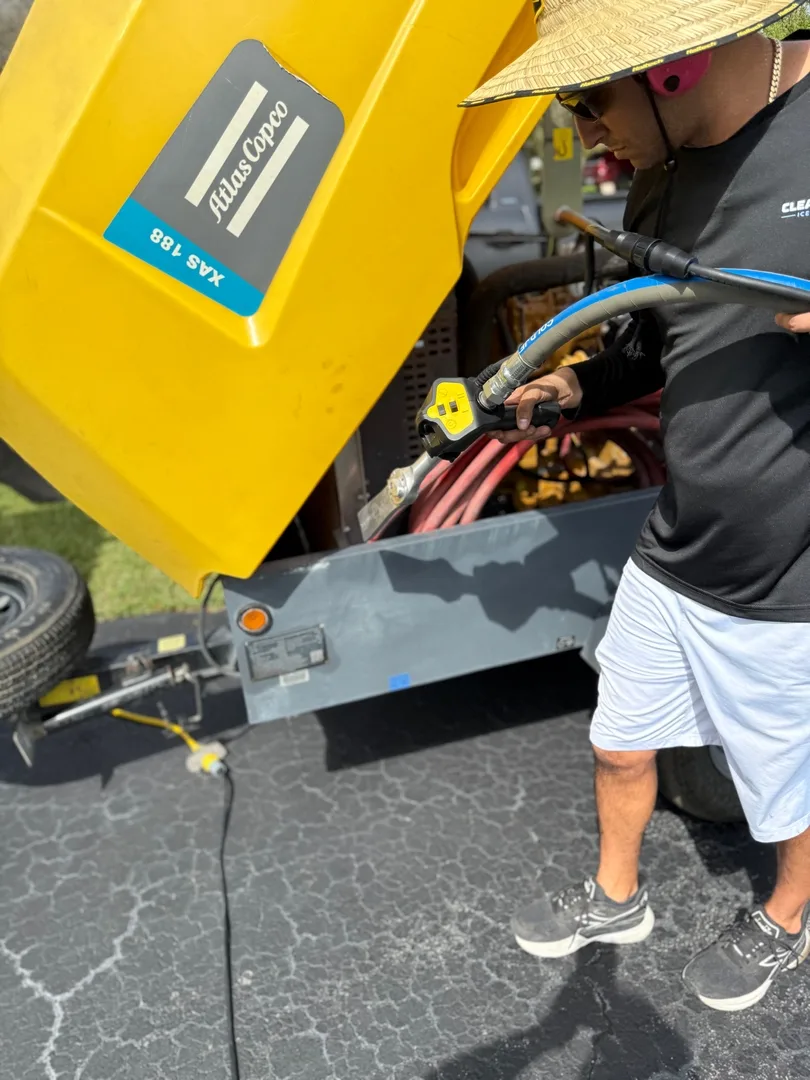
The method
Why dry ice and not the alternatives
- Non-abrasive
Tolerances stay where they were. Nothing hard hits the part, so a mold face or a bearing seat is not worn by the cleaning.
- Low moisture
No water means no rust starting in a seam you cannot see, and no moisture trapped behind a gasket or under trim.
- No secondary waste
No pile of sand in the corners afterward. The pellet is gone on impact, and only the original contaminant needs cleaning up.
- Often no teardown
In-place cleaning is the norm. Minimal disassembly means less time with the equipment offline and fewer parts to put back.
More industrial work
Related jobs we get called for
Questions we get asked first
Will it damage the surface underneath?
It should not. Unlike sand or grit, the pellet does not cut into the material. It shocks the deposit loose with cold and then turns to gas. On anything delicate or unusual we try a hidden area first.
Do you have to take the equipment apart for weld cell?
Sometimes a guard or a cover comes off so we can get the nozzle where it needs to go. Full teardown is rare. We will tell you which parts, if any, before the day of the job.
How much mess does it make?
Less than you would think. There is no water, so there is no runoff, and no media, so there is nothing to recover except the dirt.
Do you come to us?
Every job is on site. Your car can stay in your garage and your boat at the dock while we work. We cover South Florida, from Miami out to about a hundred miles.
What does a job cost?
Honestly, it depends, and we would rather not quote blind. A few photos and a sentence about the access usually give us enough to price it properly.
How soon can you look at it?
There is no dispatcher in the middle. Giancarlo or Kenny reads what you send and calls you back, so the conversation about timing starts with the people doing the work.
The comparison
The other ways to do this
- Hand scraping
Fine on a patch, hopeless on a machine, and the blade leaves its own evidence.
- Media blasting
It works by removing material, which is the problem. Acceptable on heavy steel, damaging on soft alloy, plating or a machined surface.
- Pressure washing
Drives water into harnesses, bearings, panels and seams, then everything waits to dry. On electrical work it is simply not an option.
- Solvent and degreaser
It dissolves the deposit and often the finish underneath, then leaves a film behind either way.
- Dry ice
Cold breaks the bond and the media vanishes. The substrate is untouched and there is no second mess to clean up.
What comes off
What comes off, and why
If you are wondering whether your buildup is a fit, start with this list. It is not every contaminant we handle, just the ones that come up again and again.
- Food residue
Carbonized product, fat, starch and sugar build-up on processing equipment, cleaned without chemicals touching a food contact surface.
- Grease and oil
Oil film is the layer everything else sticks to. Remove it and half the job is already done.
- Carbon and soot
Heat-bonded black deposit. Because heat put it there, a sudden cold front is what breaks its grip.
- Adhesive and sealant
Bonded material that outlived whatever it was bonding, usually harder to shift than the part it is on.
- Resin and mold release
Release agent and resin build-up on tooling, where a solvent fix trades one residue for another.
- Paint and coatings
Taken off in a controlled way when what is underneath matters more than speed.
- Salt and corrosion product
The year-round problem on the coast. The finish holding corrosion back has to survive the cleaning.
How a job runs
Nothing about this should be a surprise
Nobody should have to guess what they booked. This is every stage of a job in the order it happens.
- We test a small area
Sensitive equipment gets the same treatment as a show car: a hidden patch first, at low pressure, before the hose goes anywhere near what matters.
- We blast, then clean up
The ice is gone on impact. What is on the floor afterward came off your machine, and clearing it is ours to do.
- You look before we pack up
A second pass while everything is still connected is free in every sense. A return trip is not.
- You describe the job
What it is, what is on it and whether it can stop. If the answer is that dry ice is wrong for it, you get that answer first, not last.
- We look at access and containment
Hose run, compressor position, what needs masking, and where the contaminant is collected. For food and electrical jobs the containment plan takes longer to settle than the blasting does.
What to expect on site
Anything nearby that should not be touched gets masked before we start. That is quicker than explaining it afterward.
Dry ice is carbon dioxide in solid form. It is non-toxic and leaves no residue, but it does displace oxygen in an enclosed space, so ventilation is part of the setup rather than an afterthought.
Expect noise. Everybody inside the working area wears hearing protection, us included.
Once we stop, the surface stays cold for a while. That is normal, and it is the only thing left behind.
Describe what you are dealing with.
Tell us about the job in your own words and attach photos if you can. One of the two owners, Giancarlo or Kenny, calls you back.