Home / Service areas / Miami-Dade County / West Little River
Miami-Dade County · Florida
West Little River dry ice blasting
West Little River calls tend to arrive with a constraint attached, which is exactly where this method earns its keep.
The practical side
Everything arrives on the van: compressor, hose, operator and containment. Which means no downtime spent in transit and no risk of damage moving it out of West Little River and back.
The media is gone by the time it has done its work, so there is no sand to vacuum and no water to mop. Only the contaminant is left, and that leaves with us.
What we clean
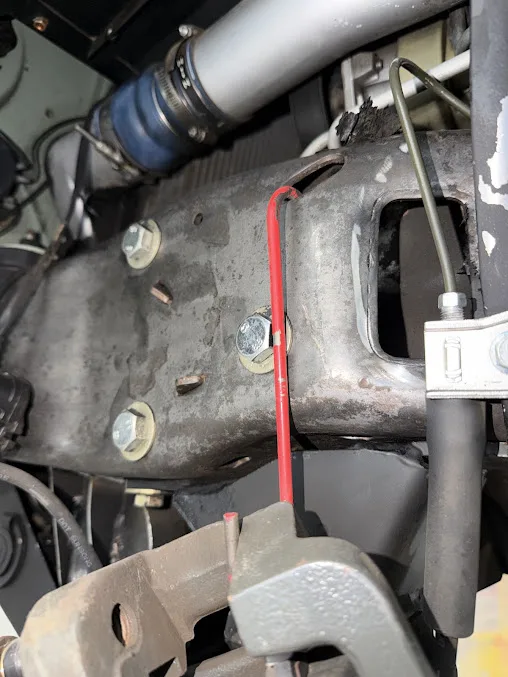
The work we take on around West Little River
Nearby
Also working across Miami-Dade County
Questions from West Little River
What do most jobs look like?
Everything from an engine bay in a driveway to a production line at shutdown. The process is the same, pointed at a different problem.
Do you charge for the drive?
It depends how far out the job is. We will be straight with you about it when you describe the work.
How do I get started?
A short description and a couple of pictures is enough to start. An owner rings you back.
Will you travel to West Little River?
Yes. West Little River is inside our regular working area, and the rig travels to the job rather than the other way round.
Do you need anything set up before you arrive?
Just access and parking. There is no tap to find, no drain to use and nothing of yours to plug into.
Can you come outside business hours?
Often yes, a lot of industrial work happens overnight or during a planned outage. Give us the window and we will say straight away whether it is realistic.
The local conditions
The heat matters more than people expect: baked-on residue cures harder in a South Florida summer. That is why so much of the work is removing what has bonded to a surface without taking the surface with it.
Light industrial, automotive and marine make up most of what we are called out for. Site type barely matters when the air, the hose and the collection all arrive together.
Because the media sublimates, there is no slurry running toward a storm drain and no grit left in a machine. On a tight site in Miami-Dade County that is often the deciding factor.
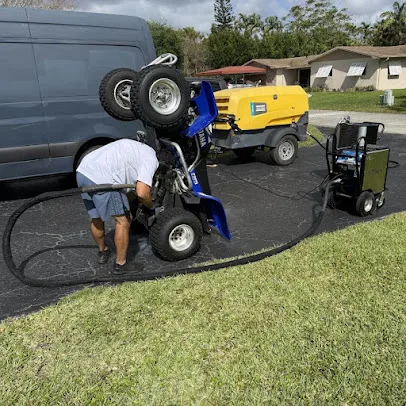
What comes off
What comes off, and why
Most of what we remove falls into a handful of families. Each one is bonded a little differently, which is why the notes below say why the cold breaks it loose.
- Food residue
Carbonized product, fat, starch and sugar build-up on processing equipment, cleaned without chemicals touching a food contact surface.
- Grease and oil
Machinery runs on lubricant, and the overspray collects lint and metal fines around every bearing and housing. The ice takes the film and the dirt stuck in it together.
- Carbon and soot
Black buildup from heat and smoke on burners, housings and fixtures. Thermal shock does the work here, with no grit grinding at the part.
- Adhesive and sealant
Sealant squeezed out and cured where it was never supposed to set.
- Resin and mold release
Residue from production that has hardened onto molds. We remove it with cold instead of chemistry, so there is nothing to rinse away afterward.
- Paint and coatings
Taken off in a controlled way when what is underneath matters more than speed.
- Salt and corrosion product
The year-round problem on the coast. The finish holding corrosion back has to survive the cleaning.
How a job runs
Nothing about this should be a surprise
Nobody should have to guess what they booked. This is every stage of a job in the order it happens.
- You look before we pack up
Inspect it with the rig still set up. Anything you are not happy with gets another go before we leave.
- You describe the job
Give us the basics in plain words: the equipment and what is stuck to it, and where it is. One of the owners reads it, and if the honest answer is that you need a different method, that is the answer you get. We would rather lose the job than sell you the wrong one.
- We look at access and containment
The layout decides the method more often than the contaminant does. We work out reach and containment before quoting anything.
- We test a small area
We dial the rig in on something nobody will notice. Older paint and soft metals in particular can react differently from what you would expect, so we check rather than assume.
- We blast, then clean up
There is no spent media to recover, only the deposit, which we collect before packing up.
The comparison
Why not just pressure wash it
- Hand scraping
Slow, inconsistent, and the tool marks the surface. Fine for a small area, unworkable across a machine.
- Media blasting
Abrasive by definition. Anything with a tolerance or a finish worth keeping comes out changed.
- Pressure washing
Water gets into everything and has to come out again before the equipment runs. Around electrics it is off the table entirely.
- Solvent and degreaser
It dissolves the deposit and often the finish underneath, then leaves a film behind either way.
- Dry ice
The pellet is soft and the mechanism is temperature, not abrasion. It turns to gas on impact, so the only thing left to sweep up is what came off.
What to expect on site
We cover what should not be hit before anything gets blasted. It takes minutes and saves arguments.
Ventilation is part of how we plan the job from the first conversation. It is never a step we add halfway through after the room starts to feel stuffy.
Dry ice blasting is noisy. Anyone close to the work wears hearing protection, and we will ask you to keep your distance or put some on.
If you plan to put the part back to work right away, allow a few minutes. It comes off cold and may gather condensation before it reaches room temperature.
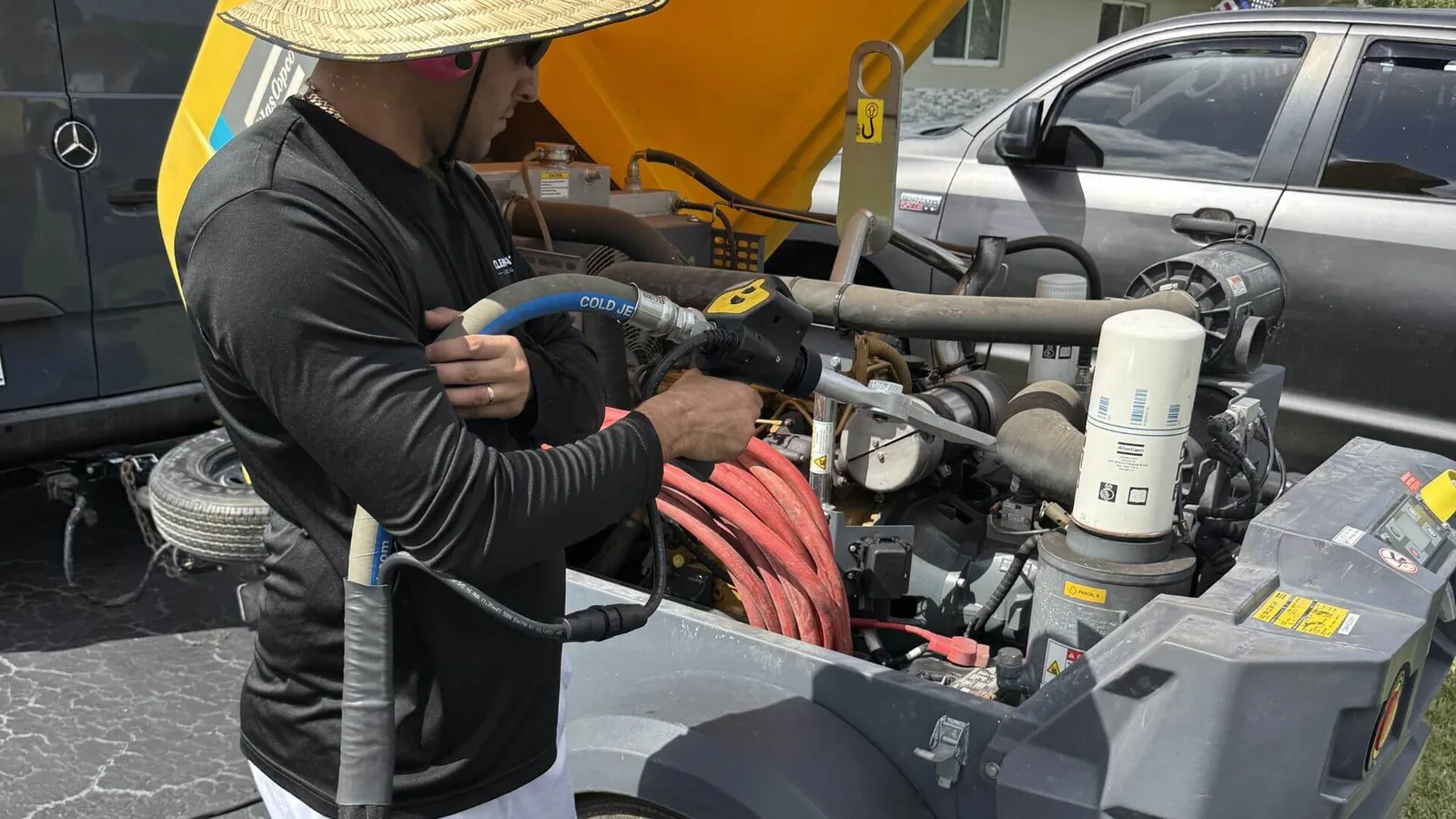
Send us the job.
There is no sales pitch on the other end. Two firefighters own this business, and one of us will call you to talk through the job.